

- ✓Who is the father of principles of management?
- ✓What are Fayol's 14 principles of management?
- ✓How are Fayol's principles different from Taylor's?
Last updated 14 May 2026 by Rishi Kumar, Senior Education Researcher and Founder, EdifyEdu. Reference material sourced from Fayol's Administration Industrielle et Generale (1916), Catherine Rymsha (UMass Lowell), Stephen Robbins' Management textbook, and standard BBA plus MBA management theory curricula.
Henri Fayol's 14 Principles of Management: What They Are and Why They Still Matter
Henri Fayol turned a company around. Not metaphorically. He took over a nearly bankrupt French mining firm, Commentry-Fourchambault, in 1888, and by the time he retired in 1918, it was financially sound. His management practices worked, so he wrote them down. That 1916 book, Administration Industrielle et Generale, gave us the 14 principles of management.
More than a century later, these principles are still taught in every BBA and MBA program in India, and still applied, sometimes unknowingly, in companies of every size. Here is what each one actually means.
Who Was Henri Fayol?

Born in Istanbul in 1841 to a French family, Fayol trained as a mining engineer at the prestigious Ecole Nationale Superieure des Mines in Saint-Etienne. He spent his entire career at one company. His contribution was not to invent management. It was to be the first person to systematically study it and write it down in a way that could be taught.
That is why he is called the father of modern management theory. Frederick Taylor, his contemporary, was focused on shop-floor efficiency. Fayol was thinking about the whole organization, from the top down.
The one thing Fayol got right that still matters: management can be learned. It is not a personality trait. That insight alone was radical in 1916.
All 14 Principles With Details That Actually Matter
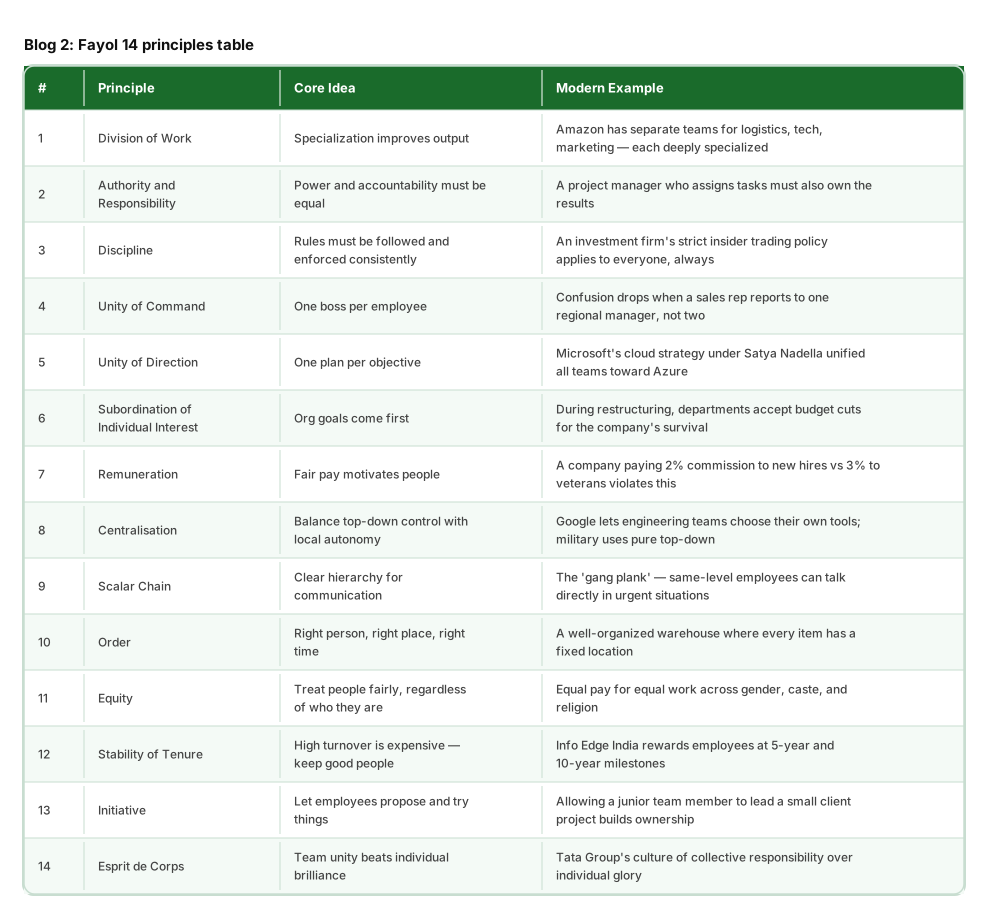
| Principle | Core Idea | Modern Example |
|---|---|---|
| 1. Division of Work | Specialisation increases efficiency | Engineering team has frontend, backend, DevOps specialists |
| 2. Authority and Responsibility | Right to give orders balanced by accountability | Manager has authority to fire plus is accountable for team output |
| 3. Discipline | Respect for organisational rules plus values | Code of conduct enforced consistently across all levels |
| 4. Unity of Command | One employee receives orders from one superior | Engineer reports only to manager, not also to PM directly |
| 5. Unity of Direction | One goal, one plan, one head per group | Marketing team aligned to single quarterly OKR |
| 6. Subordination of Individual Interest | Organisation goal supersedes individual goals | Engineer accepts overnight deployment for product launch |
| 7. Remuneration | Fair compensation for work plus contribution | Equal pay for equal work, performance bonus tied to deliverables |
| 8. Centralisation | Balance between centralised plus decentralised decision-making | Strategic decisions central, tactical decisions decentralised |
| 9. Scalar Chain | Clear chain of authority from top to bottom | Org chart with defined reporting lines plus gang-plank shortcuts |
| 10. Order | Right place for everything plus everyone | Roles plus resources clearly assigned and accessible |
| 11. Equity | Fair plus impartial treatment of employees | Anti-discrimination policy plus consistent grievance handling |
| 12. Stability of Tenure | Low employee turnover increases productivity | Career growth plans plus retention bonuses |
| 13. Initiative | Encouraging employees to take initiative plus innovate | Quarterly innovation challenges, idea-share platforms |
| 14. Esprit de Corps | Promoting team spirit plus unity | Team building events, shared mission plus vision |
The Five That Are Most Commonly Tested and Most Commonly Misunderstood
1. Unity of Command vs Unity of Direction
Students mix these up constantly. Unity of Command is about reporting lines: one employee, one boss. Unity of Direction is about objectives: one goal, one plan. You can have multiple people working toward the same goal (Unity of Direction) while each of them still reports to only one manager (Unity of Command).
2. Discipline (Not Just Rules)
Fayol's version of discipline is not a punishment framework. It is about building an environment where people respect the rules because the rules make sense. He believed discipline starts with good management, not with consequences. A poorly managed team will always have discipline problems.
3. Scalar Chain and the Gang Plank
The scalar chain is your org chart in action: communication flows from the top down. But Fayol recognized that strict adherence to this can be dangerously slow. So he introduced the concept of the gang plank, allowing employees at the same level to communicate directly when time matters, as long as they keep their superiors informed.
Find the Best online MBA for You
Compare top online MBA universities in India: fees, accreditation, placements, and specialisations side by side.
Compare MBA Universities4. Centralisation (No Right Answer)
Fayol was unusual for his time in saying that neither full centralization nor full decentralization is correct. The right balance depends on the company's size, the nature of the work, and the skill level of employees. A startup of 10 people probably needs decentralization. A nuclear plant probably needs high centralization. Most companies sit somewhere in between.
5. Remuneration (Fair, Not Equal)
Fair does not mean everyone earns the same. It means people earn what their contribution is worth, consistently applied. Gender pay gaps, undisclosed salary differences, and unequal bonus structures are all violations of this principle, even if they are technically legal.
Modern Application of Fayol Principles in Indian Companies 2026
- TCS plus Infosys plus Wipro: Use scalar chain heavily for project structure. Gang plank for cross-team collaboration.
- Reliance Industries: Strong centralisation at strategic level, decentralisation at business unit level.
- HUL plus ITC: Division of work plus specialisation across product categories. Equity plus stability of tenure are core practices.
- Tata Group: Esprit de corps plus stability of tenure are deeply embedded values. Long tenure plus loyalty culture.
- Indian Unicorns (Razorpay, Freshworks, Postman): Decentralisation plus initiative plus team spirit. Less scalar chain, more flat structures.
- Indian Public Sector (SBI, ONGC, BHEL): Maximum scalar chain plus centralisation plus unity of command. Order plus discipline strongly enforced.
- Indian Defence plus Government services: All 14 principles applied rigorously plus formally.
Fayol 14 Principles MBA plus BBA Exam Preparation Tips 2026
- Memorise all 14 names in order: Use DAD-UU-SR-CSO-ESI-E mnemonic (Division, Authority, Discipline, Unity-of-Command, Unity-of-Direction, Subordination, Remuneration, Centralisation, Scalar, Order, Equity, Stability, Initiative, Esprit).
- Pair each principle with one example: Helps in scenario-based application questions.
- Memorise definitions plus core ideas: 1 to 2 lines per principle.
- Practise scenario-based questions: Identify which principle was violated in a given scenario.
- Connect to Taylor plus other theorists: Comparative questions are common.
- Apply to current industry examples: TCS, Tata, Reliance, Razorpay cases strengthen application answers.
Criticisms Worth Knowing
Fayol's framework has real limitations. Management expert Catherine Rymsha, a lecturer at the University of Massachusetts Lowell, has noted that the principles 'work best in more structured industries' and can stifle innovation if applied rigidly in VUCA (volatile, uncertain, complex, ambiguous) environments.
The bigger critique: Fayol wrote from the top down. His framework is about managing others, not about employee motivation, psychological safety, or bottom-up innovation. You will not find anything about intrinsic motivation in these 14 principles. For that, you need later theorists like Maslow, Herzberg, or McGregor.
management specialisation in MBA is a floor, not a ceiling. His 14 principles tell you what the structure of a healthy organization looks like. They do not tell you how to inspire people.
Fayol vs Taylor: For the Exam and Beyond
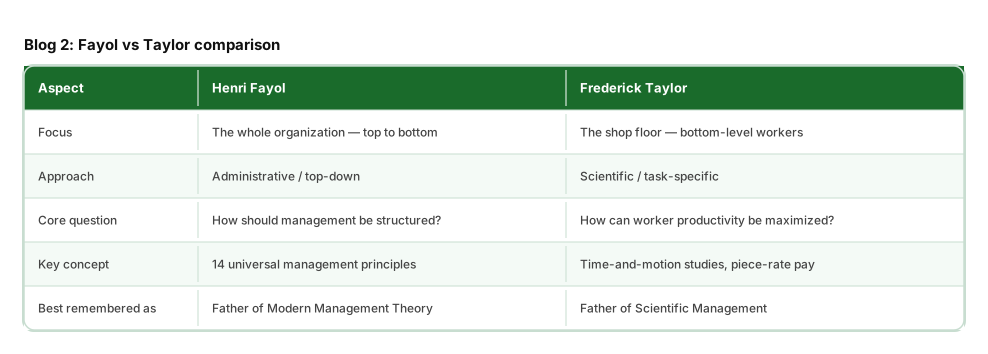
| Aspect | Henri Fayol | Frederick Taylor |
|---|---|---|
| Background | French mining engineer, CEO | American mechanical engineer |
| Approach | Top-down (general administration) | Bottom-up (shop-floor) |
| Focus | Managing the entire organisation | Improving worker productivity |
| Key Concept | 14 Principles of Management | Scientific Management plus Time-Motion Study |
| Era | 1916 Administration Industrielle | 1911 Principles of Scientific Management |
| Best Applied To | Structured large organisations | Manufacturing plus production lines |
| Father of | Modern management theory | Scientific management |
How to Use These Principles in an MBA Exam
Most exam questions on Fayol's principles ask you to: (a) identify which principle was violated in a given scenario, or (b) apply a principle to a real business situation. The most commonly tested: Unity of Command (violation = employee getting orders from two bosses), Discipline (violation = rules applied inconsistently), and Equity (violation = unequal treatment for similar roles).
When writing exam answers, always name the principle, define it briefly, apply it to the case, and state what should have been done differently. Three lines per question is usually enough.
Quick Fayol Principles Mnemonic for Exam Recall
- D: Division of Work
- A: Authority and Responsibility
- D: Discipline
- U: Unity of Command
- U: Unity of Direction
- S: Subordination of Individual Interest
- R: Remuneration
- C: Centralisation
- S: Scalar Chain
- O: Order
- E: Equity
- S: Stability of Tenure
- I: Initiative
- E: Esprit de Corps
Mnemonic: "DADU-USRCS-OESIE" or remember as 14 principles in clusters of 3-4 for easier recall during exams.
Fayol Functions of Management (Beyond the 14 Principles)
Beyond the 14 principles, Fayol also identified five core functions of management. These are often tested separately:
- Planning (Prevoyance): Looking ahead, setting goals, predicting future plus resource requirements.
- Organising (Organisation): Building organisational structure, allocating resources plus authority.
- Commanding (Commander): Directing plus motivating employees toward goals.
- Coordinating (Coordonner): Synchronising different activities plus departments.
- Controlling (Controler): Monitoring performance plus correcting deviations.
The modern POSDCORB framework (Planning, Organising, Staffing, Directing, Coordinating, Reporting, Budgeting) by Luther Gulick plus Lyndall Urwick is built on Fayol's foundation.
Application Examples: Spotting Fayol Principle Violations in Real Scenarios
- Scenario: Employee getting orders from project manager plus functional manager simultaneously. Violation: Unity of Command. Fix: Clear primary reporting line with secondary coordination.
- Scenario: Marketing team running 5 different campaigns with no coordinated goal. Violation: Unity of Direction. Fix: One quarterly OKR with aligned campaigns.
- Scenario: Two equally qualified employees receive vastly different bonuses. Violation: Equity plus Remuneration. Fix: Transparent compensation framework.
- Scenario: Communication takes 5 days from junior engineer to CEO. Violation: Scalar Chain inefficiency. Fix: Implement gang plank for urgent matters.
- Scenario: Senior engineer quits after 6 months due to micro-management. Violation: Stability of Tenure plus Initiative. Fix: Empower plus retain senior talent.
- Scenario: All decisions require CEO approval at 500-person company. Violation: Centralisation imbalance. Fix: Delegate operational decisions to mid-management.
Fayol Principles FAQ 2026
- Are Fayol's 14 principles still relevant in 2026?: Yes for structured organisations. Less applicable to agile startups plus product companies which favor flat structures.
- Which Fayol principle is most violated in modern startups?: Unity of Command. Most startups have matrix structures with cross-functional reporting.
- Can Fayol principles work alongside Agile management?: Yes. Modern hybrid management uses Fayol's structure plus Agile's flexibility.
- Is Fayol's framework taught in MBA HR?: Yes. Core in MBA HR plus Organisational Behaviour subjects.
- How are Fayol principles tested in UPSC?: UPSC Public Administration optional uses Fayol extensively. UPSC Management subject also.
- Are Fayol principles in UGC NET Management syllabus?: Yes. Mandatory for UGC NET Management paper plus Public Administration paper.
Henri Fayol's 14 Principles of Management remain foundational in 2026. They are not perfect, and they do not cover modern themes like employee motivation, psychological safety, or innovation culture. But they provide the structural skeleton of organised management that has supported large enterprises for over a century. Master them for MBA exams, then apply them critically (not rigidly) in real business situations. Pair Fayol with Taylor, Maslow, Herzberg, and McGregor for full management theory coverage. Used together, these frameworks provide the comprehensive vocabulary needed to analyse plus solve organisational challenges across structured plus modern business contexts.
For MBA aspirants, focus on the 5 most commonly tested principles (Unity of Command, Unity of Direction, Discipline, Scalar Chain, Equity) for short-form questions. Memorise all 14 names plus core ideas for long-form questions. Practise scenario-based application plus comparison with Taylor's Scientific Management theory. Done well, Fayol questions become reliable scoring opportunities in MBA plus BBA plus UPSC plus UGC NET examinations.
Find the Best Online MBA for You
Compare top online MBA universities in India: fees, accreditation, placements, and specialisations side by side.
Compare MBA UniversitiesFind the Best Online MBA for You
Compare top online MBA universities in India: fees, accreditation, placements, and specialisations side by side.
Frequently Asked Questions
Henri Fayol is called the father of modern management theory. He developed the 14 principles of management based on his experience running a mining company in France.
Division of Work, Authority and Responsibility, Discipline, Unity of Command, Unity of Direction, Subordination of Individual Interest, Remuneration, Centralisation, Scalar Chain, Order, Equity, Stability of Tenure, Initiative, and Esprit de Corps.
Fayol focused on managing the entire organization from a top-management perspective. Taylor focused on improving worker productivity at the shop-floor level through scientific methods. Both are important in management theory but address different problems.
This violates the Unity of Command principle, which states that each employee should receive instructions from only one superior.
Was this article helpful?
Share this article