

- ✓What is the full form of PhD?
- ✓What is PhD full form in India?
- ✓Is PhD and doctorate the same thing?
PhD Full Form: The Direct Answer
PhD full form is Doctor of Philosophy, from the Latin Philosophiae Doctor. It is the highest academic degree in India and worldwide, awarded for original research that adds new knowledge to a field. Under UGC 2022 regulations a PhD in India takes 3 to 6 years and requires a master's degree, or a 4-year bachelor's degree with high marks, for admission.
That is the short answer. The rest of this guide covers what the degree really demands: eligibility, duration, cost, the online PhD question, and career scope in India.
PhD full form: the name and what it actually means

PhD stands for Doctor of Philosophy. The term comes from the Latin Philosophiae Doctor, and the word 'philosophy' here isn't about studying Plato. It traces back to the Greek word meaning 'lover of wisdom.' So a PhD, in any subject (engineering, commerce, medicine, education) means you have made an original contribution to human knowledge in that field.
You can write PhD or Ph.D., both are accepted. In some British universities, it is written as DPhil. The degree is the same regardless of the abbreviation.
In India, the PhD full form in education contexts is used identically: Doctor of Philosophy. Whether you are pursuing a PhD in Education, a PhD in Management at an IIM, or a PhD in Computer Science at an IIT, the title and the rigor expected are the same.
A PhD is not just the highest degree. It is a research output. You are adding new knowledge, not summarizing what is already known.
PhD vs doctorate: is there a difference?
People use these terms interchangeably, and mostly that is fine. But technically, a doctorate is the category. A PhD is the most common type of doctoral degree. Other doctorates exist:
- DBA, Doctor of Business Administration. More applied, less theoretical. Suited for working professionals in management.
- EdD, Doctor of Education. Used in some countries for education practitioners.
- MD, Doctor of Medicine. In India, this is a postgraduate medical specialization, separate from the PhD system.
If someone in India says 'doctorate degree,' they almost always mean PhD. The DBA is gaining traction at a handful of business schools, but it is still uncommon.
How long does a PhD take in India?
Officially, 3 to 6 years. In practice, many students take longer, especially in lab sciences, where experiments do not respect deadlines.
Here is the honest breakdown:
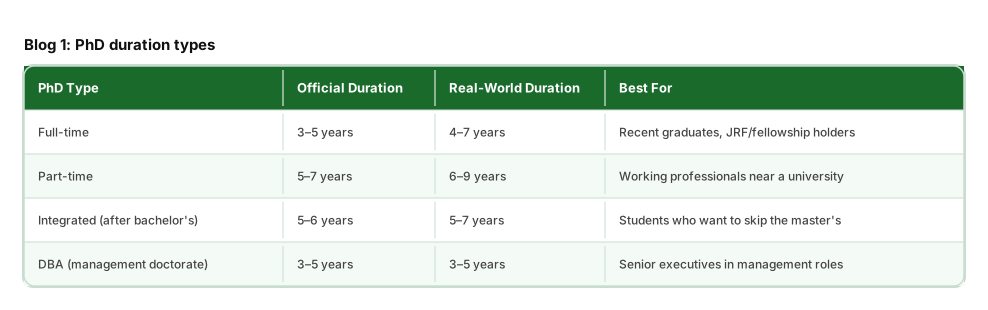
A PhD in India typically requires you to begin with coursework (usually one or two semesters), then write and defend a research proposal, publish at least one paper in a peer-reviewed journal, and finally submit and defend your thesis. The journal publication requirement is what kills timelines for most students, peer review can take 6 to 18 months per paper.
PhD Eligibility in India: UGC 2022 Rules
The UGC PhD Regulations 2022 set the entry rules. You qualify through one of two routes.
- Master's route: a postgraduate degree with at least 55% marks or an equivalent grade. Candidates from SC, ST, OBC (non-creamy layer), EWS and PwD categories qualify at 50%.
- Four-year UG route: a 4-year bachelor's degree with at least 75% marks or an equivalent grade allows direct admission, with the same relaxation for reserved categories.
Admission runs through an entrance test plus an interview. Most universities accept UGC-NET scores or conduct their own written test. Verify the current rules on ugc.gov.in before you apply, because universities update admission criteria every cycle.
Any UGC-recognised master's degree counts toward the first route. That includes an MCA or an online MBA from a UGC-DEB approved university. Still at the undergraduate stage? Degrees like BCA and B.Com lead into the master's programmes PhD admission requires.
What does it actually cost?
Government institutions like IITs and central universities charge between Rs. 10,000 and Rs. 50,000 per year in fees. If you get a JRF (Junior Research Fellowship), you also receive a monthly stipend, currently Rs. 37,000 per month for the first two years and Rs. 42,000 for subsequent years as of the 2023 revision.
Private universities are a different story. Fees can run Rs. 1 to 3 lakh per year, with stipends that are smaller or inconsistent.
Explore UGC Approved Online Programs
If you are looking to upgrade your qualifications alongside your career, explore accredited online degrees that carry full government recognition.
Browse Online Degrees →The All India Research Scholars Association has been pushing for a 60% hike in PhD stipends, arguing the current amounts are not enough to survive in most Indian cities. The call reflects a real problem: many students report using their stipends to support families, leaving nothing for research costs.
On top of fees, you should budget for journal submission charges (some journals charge $100 to $2,000 per article), conference attendance, books, and lab consumables. International journal subscriptions alone can cost thousands of rupees per paper to read, many Indian libraries do not cover them.
Is online PhD valid in India?
This is one of the most searched questions on this topic, so it deserves a direct answer: no. UGC does not recognize online PhD programs from Indian institutions. Our guide to UGC online degree rules explains which online degrees are valid and which are not.
Distance PhDs from Indian providers are also not valid. The UGC's 2020 guidelines specifically prohibit online and correspondence modes for doctoral programs, given the hands-on research requirement.
What is valid: part-time PhD programs at recognized universities, where you attend campus periodically while continuing to work. Several IITs and central universities offer this. The difference between 'part-time' and 'online' is the physical research requirement, you must be present for lab work, supervisor meetings, and institutional seminars.
There are also DBA programs from international universities that accept Indian students. These are not recognized by UGC but are recognized by international employers and some Indian private companies. Just be clear on what you are getting before you enroll.
Career scope after PhD in India
The honest picture: tenure-track university positions in India are competitive and slow-moving. Faculty positions at IITs and IIMs typically require a PhD plus postdoctoral experience plus a strong publication record. Entry-level salaries at government universities start around Rs. 8 to 12 LPA for Assistant Professor roles.
Outside academia, a PhD opens doors in:
- R&D at public-sector organizations, ISRO, DRDO, CSIR labs, BARC. These roles are permanent, structured, and respected.
- Industry R&D, increasingly, companies in pharmaceuticals, semiconductors, and AI hire PhDs for their analytical depth. Salaries here can reach Rs. 15 to 25 LPA at entry level.
- Policy and think tanks, NITI Aayog, RBI research wings, and NGOs actively recruit PhD holders for analytical and advisory roles.
- Consulting, a PhD in a specialized field (economics, engineering, healthcare) can command senior consulting rates, though this path is less formalized in India.
Planning a management doctorate later? A UGC-DEB approved online MBA satisfies the master's requirement, and many technology researchers come through an online MCA. edifyedu.in compares public UGC, NAAC and NIRF data for both, with no paid rankings.
Who should actually do a PhD?
Do a PhD if: you have a specific research question that genuinely needs answering, and you cannot stop thinking about it. That sounds romanticized, but it is the most accurate filter.
Think carefully before enrolling if: your primary motivation is the 'Dr.' title, you are escaping a bad job market, or you expect a PhD to guarantee a good salary. None of those outcomes are reliable.
A PhD in India typically takes 5 to 7 real years of your life, often at below-market compensation, with significant dependency on one person, your supervisor. That relationship can make or break the experience entirely.
That said, for the right person with the right research problem and the right supervisor, a PhD is one of the most intellectually rewarding things you can do. The key is going in with clear eyes.
PhD India 2026 EEAT Notes
Last updated 14 May 2026 by Rishi Kumar, Senior Education Researcher and Founder, EdifyEdu. PhD data verified from UGC plus AIRSA plus IIT plus IIM plus IISc plus central university PhD admission portals plus 7th Pay Commission stipend records.
Top Indian PhD Institutions 2026
| Institution | NIRF Rank | Annual Fees | JRF Stipend |
|---|---|---|---|
| IITs (Bombay, Delhi, Madras, Kanpur, Kharagpur) | Engineering 1-10 | Rs 25-50K | Rs 37-42K per month |
| IISc Bangalore | Overall 1 University | Rs 25-40K | Rs 37-42K per month |
| IIMs (A, B, C, L, K, I) | Management top 10 | Rs 30-60K | Rs 37-42K per month plus PGPX stipend |
| Central Universities (DU, JNU, BHU, AMU) | University top 50 | Rs 10-30K | Rs 37-42K per month |
| NIT Trichy, Surathkal, Warangal | Engineering 15-30 | Rs 30-50K | Rs 37-42K per month |
| Private universities (BITS, MAHE, JGU) | Mixed ranking | Rs 1-3 lakh | Rs 20-35K per month |
| State universities | Mixed | Rs 10-25K | Rs 25-37K per month (state JRF) |
PhD India Career Outcomes 2026
- Academic faculty: Rs 8-18 LPA at central universities. Rs 12-25 LPA at IIMs plus IITs plus IISc.
- Industry R&D (Big Tech, Pharma): Rs 18-35 LPA at year 1 post-PhD. Google AI, NVIDIA, Microsoft Research India hire.
- Government R&D (DRDO, ISRO, CSIR): Rs 10-18 LPA at Group A scientist. Stable career plus pension.
- Consulting plus Policy: Rs 15-30 LPA at Big 4 plus think tanks (Niti Aayog, NCAER).
- Postdoc plus Foreign career: Rs 25-50 LPA equivalent at US plus UK universities.
- Startups plus Specialised: Rs 25-45 LPA at AI-first plus biotech startups.
PhD India FAQ 2026
- Is online PhD valid in India?: No. UGC does not allow online PhD. Only campus residency-based PhD recognised.
- Is foreign distance PhD recognised in India?: Generally no. Verify via AIU plus UGC equivalence.
- How long does PhD take in India?: 3-6 years officially. Most take 5-7 years actual completion.
- Can I do PhD while working?: Part-time PhD allowed at some institutions. Online or fully distance PhD not allowed.
- What is JRF plus SRF stipend 2026?: JRF Rs 37,000 per month (first 2 years), SRF Rs 42,000 per month (year 3 onwards).
- Can I do PhD after MBA?: Yes. Many IIM plus IIT PhDs accept MBA degree holders.
PhD in India 2026 is a serious 5-7 year commitment requiring genuine research motivation plus supportive supervisor plus institutional fit. UGC does not currently allow online PhD programmes. Campus residency is mandatory. JRF stipend at Rs 37,000-42,000 per month plus low government fees make PhD financially viable for serious candidates. Career outcomes post-PhD span academia, industry R&D, government science, consulting, plus international opportunities. Match the PhD path to genuine research interest plus career goal plus 7-year time horizon for the commitment.
PhD Admission Process India 2026
- Step 1: Identify research area plus 5-7 target institutions plus potential supervisors.
- Step 2: Prepare research proposal plus statement of purpose plus academic CV.
- Step 3: Take entrance exam (UGC NET, GATE, JEST, NBHM, or institute-specific).
- Step 4: Submit application plus pay fees Rs 500-2,500.
- Step 5: Personal interview plus research presentation.
- Step 6: Admission confirmation plus supervisor allotment.
- Step 7: Begin coursework (typically 1-2 semesters) plus comprehensive exam.
- Step 8: Confirm research topic plus committee approval.
- Step 9: Conduct research, publish 1-2 journal papers.
- Step 10: Submit thesis plus defend at viva voce. Receive PhD degree.
PhD Funding Options India 2026
- UGC NET JRF Fellowship: Rs 37K-42K per month. Most prestigious. Through UGC NET exam.
- CSIR-UGC NET JRF: Same fellowship for science subjects.
- ICMR JRF: For medical sciences PhD. Rs 35-40K per month.
- ICAR JRF: For agriculture sciences PhD. Rs 31-35K per month.
- DST INSPIRE Fellowship: For science plus technology PhD. Rs 35-40K per month.
- Prime Minister Research Fellowship (PMRF): Rs 70K-80K per month at IITs, IISc, IIITs. Most lucrative.
- Project fellowships: Linked to specific research projects, Rs 25-37K per month.
- Industry-sponsored PhD: Some companies sponsor PhD with stipend Rs 50K-1 lakh per month.
Indian PhD candidates have multiple funding pathways. UGC NET JRF plus PMRF are the most prestigious plus highest-paying. PhD financial planning matters because the 5-7 year timeline requires sustained income source. Plan funding strategy along with research topic plus institution choice before commitment.
The Indian PhD ecosystem in 2026 has become more competitive plus globally aligned. IITs plus IISc plus IIMs publish in top-tier international journals. Industry R&D at Google India, Microsoft Research India, Adobe Research plus pharmaceutical R&D actively hire Indian PhDs. The 5-7 year investment, when matched with right research question plus supervisor plus institution, delivers measurable career returns through academic plus industry plus international career pathways.
For 2026 PhD aspirants, the critical first steps are identifying genuine research interest, mapping target institutions plus supervisors, plus preparing entrance exam (UGC NET, GATE, JEST, PMRF screening). Funding plus stipend planning matters equally. The 5-7 year commitment requires sustained financial support plus emotional resilience plus institutional fit. With right preparation plus institution match plus supervisor relationship, the Indian PhD remains one of the most intellectually rewarding career paths plus a strong pathway into academia, industry R&D, government science, plus international opportunities.
Explore UGC Approved Online Programs
If you are looking to upgrade your qualifications alongside your career, explore accredited online degrees that carry full government recognition.
Compare Online DegreesExplore UGC Approved Online Programs
If you are looking to upgrade your qualifications alongside your career, explore accredited online degrees that carry full government recognition.
Frequently Asked Questions
PhD full form is Doctor of Philosophy. It comes from the Latin term Philosophiae Doctor and represents the highest academic degree awarded for original research.
In India the PhD full form is the same, Doctor of Philosophy. Indian universities award it under UGC 2022 regulations after 3 to 6 years of original research completed after a master's degree.
A doctorate is the broader category. A PhD is a type of doctorate. Other doctorates include the DBA (Doctor of Business Administration) and EdD (Doctor of Education).
The official duration is 3 to 6 years. Realistically, most students take 5 to 7 years, depending on research complexity, publication requirements, and supervisor availability.
Under UGC 2022 regulations you need a master's degree with at least 55% marks (50% for reserved categories) or a 4-year bachelor's degree with 75%, plus an entrance test such as UGC-NET and an interview.
No. UGC does not recognize online or correspondence PhD programs from Indian institutions. Part-time PhDs at recognized universities are valid, provided there is genuine campus presence and research activity.
Was this article helpful?
Share this article