

- ✓What is the CAT 2026 syllabus?
- ✓Which IIM is conducting CAT 2026?
- ✓How many questions are in CAT 2026?
Last updated 14 May 2026 by Rishi Kumar, Senior Education Researcher and Founder, EdifyEdu. CAT data verified from iimcat.ac.in, IIM Indore CAT 2025 notification, plus 10-year historical CAT pattern analysis.
CAT Exam Syllabus 2026: The Honest, Section-by-Section Breakdown
Let us be direct about something: the IIMs do not publish an official CAT syllabus. Not ever. What you will find on the internet (including this guide) is a reconstruction built from 10-plus years of actual CAT papers. The good news is that the exam has been remarkably consistent. The core topics have not changed significantly since 2019.
CAT 2026 is expected to be held on November 29, 2026, based on patterns from previous years. IIM Kozhikode conducted CAT 2025. Here is everything you need to know about what is actually tested.
The Exam in Numbers

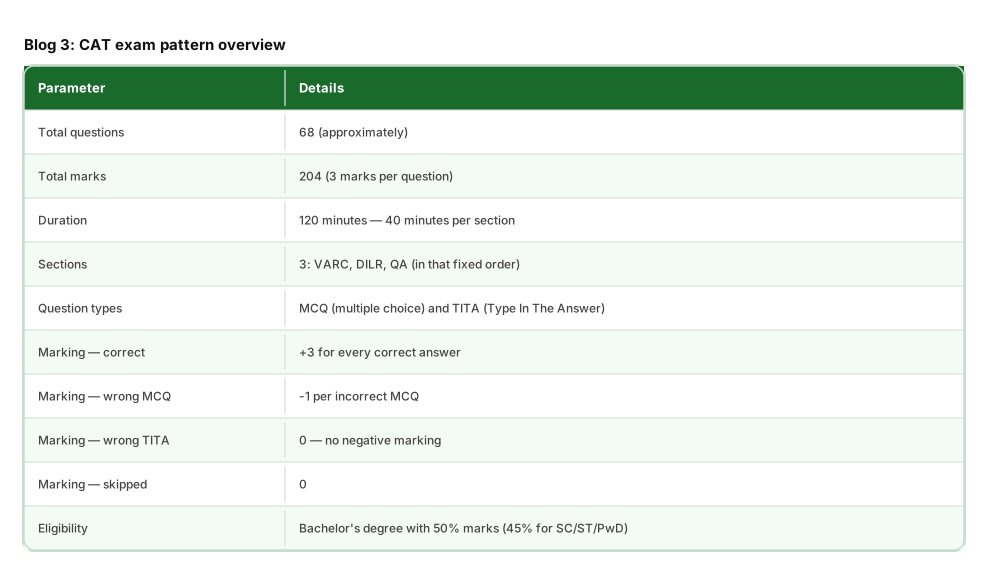
One thing toppers consistently say: TITA questions are gifts. No negative marking means you should attempt every single TITA question, even when uncertain. This alone can add 10-15 marks to your score.
Section 1: VARC Verbal Ability and Reading Comprehension (24 questions, 40 minutes)
VARC has two parts, and they are not equal:
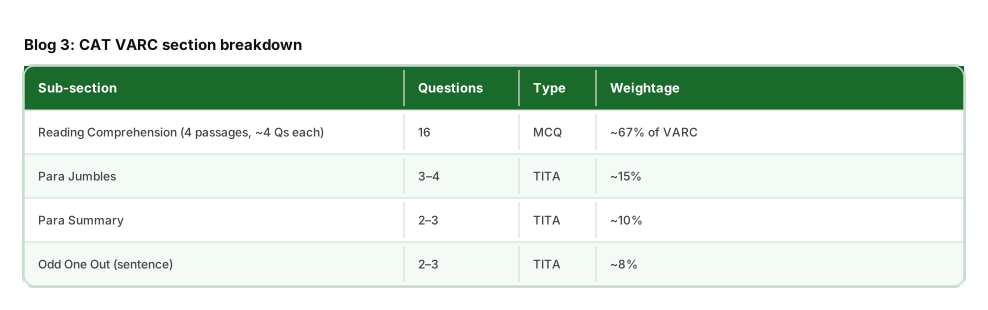
RC passages are typically 500 to 900 words, drawn from topics like economics, philosophy, social science, science, and literature. They are not predictable by topic, what is predictable is the question style: inference, main idea, tone, author's intent.
Here is what most guides will not tell you: CAT stopped testing direct vocabulary and grammar after 2016. If you are making word lists, stop. The VARC section only measures whether you can read complex English with comprehension and speed. That requires reading, not memorizing.
A practical tip: read at least one article daily from publications like Aeon, The Economist, or The Hindu's opinion section. Not to find CAT topics. To build the mental stamina to read dense writing quickly.
Section 2: DILR Data Interpretation and Logical Reasoning (22 questions, 40 minutes)
DILR is the most feared section and for good reason. Unlike VARC (which rewards reading) and QA (which rewards mathematical skill), DILR rewards a type of thinking that is harder to build, the ability to decode unfamiliar puzzle formats under time pressure.
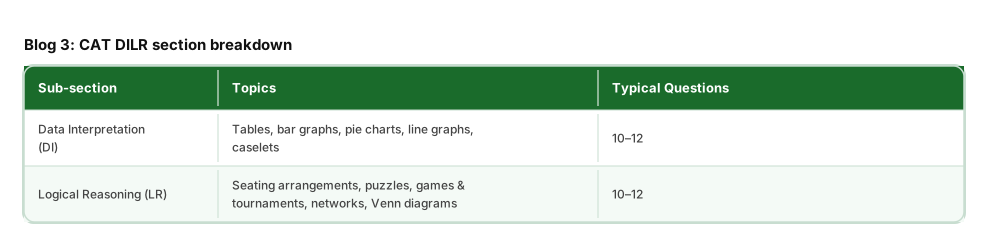
DILR comes in sets, usually 4 to 5 sets of 4 to 6 questions each. The catch: if you cannot crack the logic of a set in the first 2 minutes, it is often better to skip the entire set and move on. Spending 15 minutes on one set and getting it wrong costs you more than abandoning it.
Recent CAT papers (2022-2025) have featured increasingly unconventional set types: sports tournaments with unusual scoring rules, data games, network flow problems. The only way to prepare is to solve hundreds of diverse sets, not just practice traditional bar graph questions.
The DILR section is pure skill, no academic subject knowledge required. A literature student with good analytical thinking can outscore an engineer here. Practice is the only differentiator.
Section 3: QA Quantitative Ability (22 questions, 40 minutes)
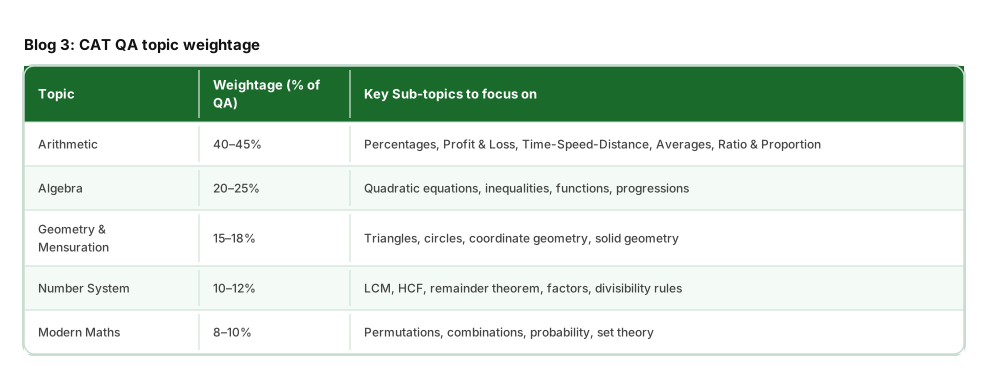
QA tests mathematics at roughly Class 10 to 12 level, but with a twist. The questions require application and multi-step reasoning, not formula recitation. Speed matters as much as accuracy.
Ready to Upgrade Your Qualifications?
Compare 50+ UGC DEB approved universities offering online MBA, MCA, BBA, BCA, B.Com all in one place.
Compare UniversitiesArithmetic alone covers 8 to 10 questions per paper consistently over the last five years. If you get your arithmetic fundamentals right, you can realistically target 50 to 60 percent of QA marks before touching geometry or modern maths.
One thing worth knowing: the QA section increasingly uses TITA questions (around 6 to 8 per paper). These tend to have cleaner, integer answers. Develop the habit of checking whether your answer is a whole number. If it is not, you likely made an error.
CAT Section Wise Detailed Topic Coverage 2026
| Section | Sub-Topics | Weightage |
|---|---|---|
| VARC (24 Qs) | RC passages (16-18 Qs), Para-completion, Para-jumbles, Para-summary (6-8 Qs) | 72 marks |
| DILR (22 Qs) | Data Interpretation tables, Graphs (8-10 Qs), Logical Reasoning puzzles plus games (12-14 Qs) | 66 marks |
| QA (22 Qs) | Arithmetic (8-10 Qs), Algebra (4-6 Qs), Geometry (3-5 Qs), Modern Maths plus Number System (3-5 Qs) | 66 marks |
CAT Score to Percentile Mapping (Approximate 2026)
| CAT Raw Score | Approximate Overall Percentile | Target IIM Tier |
|---|---|---|
| 110-plus | 99.9-plus | IIM A, B, C top spots |
| 95-105 | 99 to 99.8 | IIM A, B, C plus L, K, I |
| 85-95 | 96 to 99 | IIM L, K, I plus newer IIMs |
| 75-85 | 90 to 96 | Newer IIMs plus top non-IIM |
| 65-75 | 80 to 90 | Tier-2 PGDM plus MBA colleges |
| 55-65 | 70 to 80 | Tier-3 colleges |
The Marking Scheme: What It Means for Strategy
The plus 3 minus 1 structure for MCQs means that random guessing hurts you. Four wrong MCQs cancel out one correct answer. This is why most high scorers recommend attempting MCQs only when you have eliminated at least two options. The odds then shift in your favor.
TITA questions are the opposite: with no negative marking, the only rational strategy is to attempt all of them. Even a partially reasoned answer on a TITA question might land you 3 marks. A blank gives you zero.
How to Build a Preparation Plan
Most serious aspirants need 4 to 6 months of dedicated preparation. Here is a rough phase structure that works:
- Months 1 to 3: Build fundamentals. NCERT Maths (Class 8 to 10) for QA basics, daily reading for VARC, 1 to 2 DI plus LR sets per day.
- Month 4: Sectional mocks. Full 40-minute mock sections, reviewed question by question after each attempt.
- Months 5 to 6: Full mock tests. At least 2 per week, plus detailed analysis of every mistake.
- Final 2 weeks: Revision only. No new topics. Revisit error logs from earlier mocks.
The analysis part is what most aspirants skip and most toppers emphasize. Taking a mock is useful. Understanding why you got something wrong is what actually raises your score.
Best CAT Coaching plus Self-Study Resources 2026
- Top coaching institutes: TIME, IMS, Career Launcher, Bulls Eye, Endeavor, Hitbullseye. Fees Rs 35,000 to 1 lakh.
- Online prep platforms: Unacademy, Bodhee Prep, 2IIM, ElevateBaba. Fees Rs 10,000 to 40,000.
- Free resources: Past CAT papers (15 years), iimcat.ac.in sample papers, YouTube channels (Wifistudy, Rodha, MBA Pathshala).
- Books: Arun Sharma series, Sarvesh Verma QA, Nishit Sinha LRDI plus VA. Foundation books.
- Mock test series: TIME (Rs 5,000 to 8,000), IMS (Rs 6,000 to 10,000), CL Mock (Rs 5,000 to 8,000).
CAT 2026 Application Timeline
- Late July 2026: CAT 2026 notification expected at iimcat.ac.in.
- August-September 2026: Application window opens. Pay application fee (approximately Rs 2,400 General, Rs 1,200 reserved).
- October-November 2026: Admit card download.
- 29 November 2026: CAT 2026 exam (3 slots: morning, afternoon, evening).
- December 2026-January 2027: Results plus IIM shortlists.
- February-April 2027: WAT plus GD plus PI at IIMs.
- May 2027: Final admissions plus seat allocation.
- June-July 2027: Programme commencement.
CAT Honest Gaps and Considerations 2026
- 99-plus percentile is non-negotiable for IIM A, B, C: Even strong academics plus work experience does not compensate for sub-99 percentile.
- Sectional cutoffs matter: Each section requires 80-plus percentile (minimum). 99 overall plus 70 in QA usually fails sectional cutoff at IIM A.
- Coaching is not strictly essential: Self-study toppers exist but are minority. Coaching adds discipline plus mock-test access.
- Work experience plus academic record influence final selection: Tier-1 IIMs use composite score combining CAT, academics, work experience, gender, plus diversity factors.
- Multiple attempts are common: About 30 percent of IIM admits are second or third-time CAT attempters.
- WAT plus GD plus PI carries significant weight: 30-40 percent of final selection comes from interview round, not just CAT score.
CAT FAQ 2026
- Is CAT harder than GMAT?: Different difficulty types. CAT focuses on speed plus accuracy with shorter time. GMAT focuses on adaptive complexity. Both at top score require deep prep.
- Can engineers clear CAT easily?: Engineers do well in QA but struggle in VARC plus DILR sets. CAT favors all-rounder cognitive skills, not just quantitative.
- What is the average prep time for CAT 99 percentile?: 6 to 12 months of structured prep. 4-5 hours daily during peak prep period.
- Can working professionals clear CAT?: Yes. Many working professionals clear 95-plus percentile with 8-12 months disciplined evening plus weekend prep.
- What is the CAT 2026 application fee?: Approximately Rs 2,400 General, Rs 1,200 reserved categories.
- How many IIM seats are filled through CAT 2026?: Approximately 5,000 to 6,000 across 22 IIMs combined (IIM Guwahati, the newest, opened with a 70-seat first batch in 2026).
CAT 2025 Trends and Implications for CAT 2026
CAT 2025 was conducted by IIM Kozhikode on November 30, 2025, in three slots. Key trends and implications for 2026 aspirants:
- QA section was moderate to hard: Arithmetic plus algebra dominated. Class 10 NCERT plus Arun Sharma sufficient for most questions.
- DILR continued unconventional sets: 4 sets with tournament-style plus network puzzles. Required strong logical sequencing.
- VARC RC passages were dense: 4 RC sets of 4 questions each. Topics: philosophy, neuroscience, geopolitics, history. Reading speed plus comprehension critical.
- Para-jumbles plus Para-summary moderate: 8 questions total. Reading comprehension plus inference skills tested.
- TITA percentage stable at 25-30 percent: Approximately 17-18 TITA questions across all sections. No negative marking made them critical for high scorers.
- Top score required for IIM A, B, C: 99.95-plus percentile typical. 95-plus overall plus 80-plus sectional cutoffs strict.
CAT Preparation Strategy for Working Professionals 2026
- 6-8 month structured plan: Starting April-May 2026 for November 2026 attempt.
- Daily 2-3 hour structured study: 1 hour QA, 1 hour DILR, 30 min VARC reading.
- Weekend mock tests: 1 full mock every Saturday from August 2026 onwards.
- Active analysis log: Document every mistake plus topic gap in spreadsheet for revision.
- Peer study groups: Join IIM aspirant WhatsApp plus Discord groups for motivation plus doubt-clearing.
- Sustainability over intensity: Burnout during prep is common. Maintain consistent moderate intensity over high intensity bursts.
CAT 2026 is India's gateway to top management education. The 4-6 month structured preparation requires discipline more than raw intelligence. Master the three sections through balanced preparation, take 8-12 mock tests, analyse mistakes thoroughly, plus build sustained focus through repeated practice. Tier-1 IIM admission opens doors to consulting, investment banking, plus top product company careers worth Rs 25-50 LPA at year 1. The 12-month focused preparation effort is worth the 10-15 year career compound it creates. Pick CAT preparation deliberately, plus commit to consistent disciplined effort across the preparation cycle.
For repeat CAT attempters, focus on weakness improvement plus sectional cutoff achievement. Most second-time CAT attempters improve percentile by 5-10 points through targeted prep on weak sections. The third attempt is usually the conversion attempt if disciplined preparation continues. Build resilience plus structured improvement strategy across multi-year CAT campaigns where applicable to your career timeline plus personal goals.
Beyond CAT, evaluate XAT plus NMAT plus IIFT plus SNAP as parallel safety nets. Most serious MBA aspirants write 3-4 entrance exams in same cycle to maximise admission chances at varied tier institutes. Strategic exam plus college selection multiplies admission outcome probability beyond what CAT alone can deliver. Build the multi-exam application strategy plus prep timeline together from Day 1 of your CAT preparation cycle. The combined exam attempt strategy reduces single-exam-day risk plus opens more institute admission options across CMAT plus XAT plus NMAT plus MAT plus SNAP networks. Many high achievers attempt 4-5 exams in same calendar year to secure top institute admission across exam-cycle outcomes. Applicants targeting online MBA programmes should review MBA eligibility via CAT score to understand which universities require a CAT score and which accept direct admission.
Ready to Upgrade Your Qualifications?
Compare 50+ UGC DEB approved universities offering online MBA, MCA, BBA, BCA, B.Com all in one place.
Compare UniversitiesReady to Upgrade Your Qualifications?
Compare 50+ UGC DEB approved universities offering online MBA, MCA, BBA, BCA, B.Com all in one place.
Frequently Asked Questions
CAT 2026 covers three sections: VARC (Verbal Ability and Reading Comprehension), DILR (Data Interpretation and Logical Reasoning), and QA (Quantitative Aptitude). The exam has 66 questions in 120 minutes, with 40 minutes per section. The syllabus has remained stable since 2022. The official syllabus and pattern will be confirmed in the CAT 2026 notification expected on the last Sunday of July 2026.
CAT 2026 is expected to be conducted by IIM Indore based on the rotation pattern among the six oldest IIMs. The convening IIM is officially confirmed only when the CAT 2026 notification is released on iimcat.ac.in, expected in late July 2026. CAT 2025 was conducted by IIM Kozhikode.
CAT 2026 is expected to have 66 questions across three sections, following the same pattern as CAT 2024 and CAT 2025. VARC has 24 questions, DILR has 20 questions, QA has 22 questions. Each correct MCQ gives plus 3 marks, each wrong MCQ deducts 1 mark, and TITA (non-MCQ) questions carry no negative marking.
CAT 2026 is expected on 29 November 2026, which is the last Sunday of November, following the pattern of previous years. The exam will be conducted in three slots: morning, afternoon, and evening. The official date will be confirmed in the CAT 2026 notification released in late July 2026.
Was this article helpful?
Share this article