

- ✓What is the average data science salary in India in 2026?
- ✓What is the difference between data analyst, data scientist, and ML engineer?
- ✓Can commerce students or non-CS graduates do data science?
Last updated 14 May 2026 by Rishi Kumar, Senior Education Researcher and Founder, EdifyEdu. Salary data sourced from NASSCOM 2026 Tech Hiring Report, LinkedIn India Hiring Index April 2026, Naukri.com Job Speak 2026 Q1, and 6figr salary database analysis.
"Data science salary" articles mix three different roles into one number and call it a guide. The reality: data analyst, data scientist, and ML engineer are different jobs with different pay structures and 2x to 3x gaps based on company type. This guide separates them with current GenAI premium data, product vs services gap, city multiplier, and the certifications that actually compound salary growth.
Written for: BSc Maths or Stats or CS graduates evaluating data career entry, BTech graduates choosing between SDE and data science track, and working professionals planning a data career pivot.
The Three Roles That Get Confused

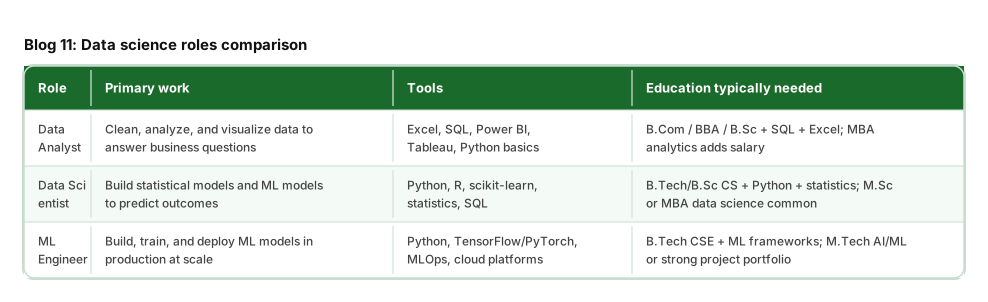
| Factor | Data Analyst | Data Scientist | ML Engineer |
|---|---|---|---|
| Primary work | Answer business questions with existing data | Build predictive models | Deploy ML to production at scale |
| Core tools | Excel, SQL, Tableau, Power BI | Python, R, SQL, ML libraries | Python, MLOps, AWS, Kubernetes |
| Maths required | Basic statistics | Statistics, calculus, linear algebra | Same as DS plus systems engineering |
| Typical education | BCom, BBA, BSc, BTech | BTech, BSc Maths or Stats, MSc | BTech CS, MTech, advanced certifications |
| Year 1 salary | Rs 4 to 8 LPA | Rs 7 to 12 LPA | Rs 9 to 15 LPA |
| Year 5 salary | Rs 12 to 18 LPA | Rs 18 to 28 LPA | Rs 22 to 35 LPA |
| Year 10 ceiling | Rs 20 to 30 LPA | Rs 30 to 60 LPA | Rs 40 to 80 LPA |
Salary by Role and Experience (Detailed)
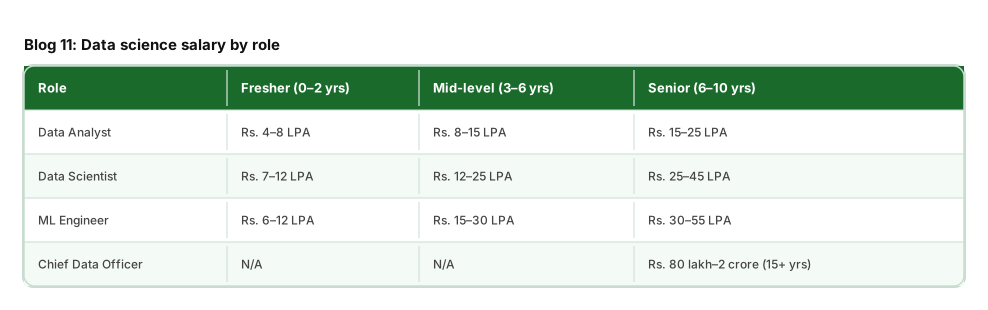
The entry-level gap between data analyst (Rs 4 to 8 LPA) and data scientist (Rs 7 to 12 LPA) is real but not enormous. The gap widens at year 5-plus. A senior data scientist at a product company earns Rs 25 to 45 LPA. A senior analyst at the same company doing similar hours tops out at Rs 18 to 25 LPA.
The GenAI and LLM Premium: 25-40 Percent Above Generalist
The biggest 2025-26 data science salary trend is the GenAI premium. Specialists in Large Language Models, fine-tuning, prompt engineering, and AI agent systems earn significantly more than generalist data scientists at the same experience level.
| Experience level | Generalist data scientist | GenAI or LLM specialist | Premium |
|---|---|---|---|
| Year 1-2 | Rs 8 to 14 LPA | Rs 12 to 22 LPA | 30 to 50 percent |
| Year 3-5 | Rs 14 to 22 LPA | Rs 20 to 32 LPA | 30 to 45 percent |
| Year 6-9 | Rs 22 to 36 LPA | Rs 32 to 50 LPA | 25 to 40 percent |
| Senior (10-plus) | Rs 36 to 55 LPA | Rs 50 to 80 LPA-plus | 30 to 45 percent |
Skills that unlock GenAI premium: LangChain, Hugging Face fine-tuning, vector databases (Pinecone, Weaviate), prompt engineering at production scale, MLOps for LLMs, retrieval-augmented generation (RAG) systems. Companies hiring aggressively: Google India, Microsoft, Razorpay, Freshworks, Sarvam AI, Krutrim, OpenAI India, Anthropic Bengaluru.
The Product vs Services Company Gap
Where you work matters as much as what you do. Same role title, very different pay.
| Company tier | Examples | Year 3 data scientist CTC |
|---|---|---|
| Big Tech (FAANG plus tier) | Google India, Microsoft, Amazon, Meta, Apple India | Rs 30 to 55 LPA (incl equity) |
| Indian unicorn product | Razorpay, Flipkart, Meesho, Swiggy, Zomato | Rs 22 to 38 LPA |
| Mid-stage Indian product | Freshworks, Postman, Innovaccer, Druva | Rs 18 to 30 LPA |
| BFSI digital banking and fintech | HDFC Bank Digital, Paytm, PhonePe, BharatPe | Rs 15 to 25 LPA |
| Consulting Analytics | McKinsey QuantumBlack, BCG Gamma, Deloitte Analytics | Rs 22 to 36 LPA |
| Indian IT services | TCS, Infosys, Wipro, HCL, Tech Mahindra | Rs 9 to 15 LPA |
| Captive R&D centres (non-FAANG) | Samsung R&D, Adobe India, Salesforce, Oracle | Rs 16 to 28 LPA |
Takeaway: a year-3 data scientist at TCS earning Rs 12 LPA and a year-3 data scientist at Razorpay earning Rs 28 LPA do similar work. The 2.3x gap is real. Plan your career to move services-to-product by year 3.
The Indian City Multiplier
| City | Salary multiplier vs Bengaluru | Cost of living multiplier | Net wealth gain |
|---|---|---|---|
| Bengaluru | 1.00x (baseline) | 1.00x | Baseline |
| Mumbai | 0.95 to 1.05x | 1.10x (rent higher) | Marginally lower than Bengaluru |
| Delhi NCR (Gurgaon, Noida) | 0.90 to 1.00x | 0.95x | Roughly same as Bengaluru |
| Hyderabad | 0.85 to 0.95x | 0.75x | 10 to 15 percent higher net savings |
| Pune | 0.80 to 0.90x | 0.85x | Roughly same as Bengaluru |
| Chennai | 0.75 to 0.85x | 0.75x | Roughly same as Bengaluru |
| Tier-2 cities (Indore, Jaipur, Kochi) | 0.60 to 0.75x | 0.55x | 15 to 25 percent higher net savings |
Skills That Actually Move Salary
Two candidates with Python and SQL get evaluated on what they built with the tools, not the tools themselves. But some skills consistently unlock higher packages. For benchmarks across experience levels, see the salary after data science MBA guide.
- Python: Mandatory for data scientist and ML engineer roles. Not knowing it closes those doors.
- SQL: Universal requirement across all 3 roles. Often tested in interviews. Window functions, CTEs, query optimisation.
- Cloud ML platforms: AWS SageMaker, Azure ML, Google Vertex AI. 20 to 30 percent premium at mid-senior levels.
- MLOps: Docker, Kubernetes, MLflow, Airflow, Kubeflow. 25 to 40 percent premium at senior levels.
- NLP and LLMs: GenAI premium 25 to 40 percent. Hugging Face, LangChain, vector databases, fine-tuning.
- Deep Learning frameworks: PyTorch, TensorFlow. Premium at product company and research roles.
- Business communication: Translating model output to business impact. Senior salary multiplier.
- Domain expertise (BFSI, healthcare, supply chain): Specialised data scientists with deep domain knowledge earn 15 to 25 percent more.
Certifications That Actually Compound Salary
| Certification | Cost | Salary impact | Best stage |
|---|---|---|---|
| AWS Certified Machine Learning Specialty | USD 300 exam | 15 to 25 percent salary bump at mid-level | Year 2 onwards |
| Google Cloud Professional ML Engineer | USD 200 exam | 15 to 25 percent at mid-level | Year 2 onwards |
| Microsoft Azure AI Engineer Associate | USD 165 exam | 10 to 20 percent at mid-level | Year 2 onwards |
| Coursera Deep Learning Specialization (Andrew Ng) | USD 49 per month, ~3 months | Strong on resume; helps fresher placement | Year 0-1 |
| Hugging Face NLP Course (free) | Free | GenAI signal for LLM roles | Year 0-2 |
| Stanford ML Specialization Coursera | USD 49 per month, ~4 months | Strong academic signal for senior interviews | Year 2 onwards |
| IIM or ISB Executive Programmes in Analytics | Rs 3 to 5 lakh | 15 to 25 percent at mid-level, opens management track | Year 3 onwards |
Top Companies Hiring Data Professionals in India 2026
- Big Tech (highest pay): Google India, Microsoft, Amazon, Meta, Apple India. Rs 25 to 45 LPA fresher to Rs 80 LPA-plus senior.
- Indian unicorns and SaaS: Razorpay, Flipkart, Meesho, Swiggy, Freshworks, Postman, PhonePe. Rs 14 to 28 LPA fresher.
- BFSI digital arms: HDFC Digital, ICICI Lab, Paytm, BharatPe, CRED. Rs 10 to 22 LPA fresher.
- Consulting Analytics: McKinsey QuantumBlack, BCG Gamma, Deloitte Analytics, EY DnA. Rs 12 to 22 LPA fresher.
- Healthcare and pharma data: Practo, Apollo, Dr Reddy's analytics, Mylan analytics. Rs 8 to 15 LPA fresher.
- Indian IT services: TCS, Infosys, Wipro, HCL, Cognizant, Tech Mahindra. Rs 6 to 12 LPA fresher.
Explore online MCA Programs in 2026
Compare 50+ UGC DEB approved universities offering online MCA. Fees, syllabus, specialisations, and career outcomes in one place.
Compare MCA UniversitiesMBA in Data Science: Worth It or Skip?
An MBA with Business Analytics or Data Science specialisation combines management with analytics. Useful for roles at the intersection of strategy and data: business analytics manager, product analytics lead, chief data officer track.
- Worth it if: You want management-track data roles, plan to lead teams, target Chief Data Officer or Director Analytics by year 10-12.
- Skip if: You want pure technical data scientist or ML engineer career. MSc Data Science, online MCA, or domain certifications are stronger ROI for technical tracks.
- Best MBA options for analytics: IIM A, IIM B, ISB (tier 1). For online: JAIN Online Business Analytics (A++) or Chandigarh University Online Analytics (A+) at Rs 1.5 to 2.2 lakh.
The Path from BSc or BTech to High-Paying Data Career
- Year 0 (final year): Build foundation. Python plus SQL plus 1 to 2 portfolio projects on Kaggle or GitHub.
- Year 1 (first job): Join services or BFSI digital team as junior data analyst. Rs 4 to 8 LPA. Learn production environment.
- Year 2: Add cloud ML cert (AWS or GCP) and deep learning specialisation. Move to data scientist title within company or laterally.
- Year 3: Switch to product company or BFSI digital arm. Rs 18 to 28 LPA. Build domain expertise.
- Year 4-5: Specialise in GenAI, MLOps, or specific domain. Senior data scientist track. Rs 25 to 40 LPA.
- Year 6-plus: Tech lead or management track. Online MBA Business Analytics if pursuing management. Rs 35 to 60 LPA-plus.
Honest Gaps in This Guide
- GenAI premium is real but may compress as the talent pool grows over 2026-27.
- Big Tech equity components add 30 to 50 percent to base CTC at senior levels but vary by company and grant cycle.
- Tier-2 city pay is lower in absolute numbers but the cost-of-living math often produces higher net savings.
The Year-by-Year Data Career Salary Curve
| Year | Role | Median CTC | Top decile CTC |
|---|---|---|---|
| Year 1 | Associate Data Scientist | Rs 9 to 14 LPA | Rs 18 to 25 LPA |
| Year 2 | Data Scientist | Rs 14 to 20 LPA | Rs 25 to 35 LPA |
| Year 3 | Data Scientist II | Rs 18 to 26 LPA | Rs 30 to 42 LPA |
| Year 5 | Senior Data Scientist | Rs 25 to 36 LPA | Rs 42 to 60 LPA |
| Year 7 | Staff Data Scientist or Lead | Rs 36 to 55 LPA | Rs 60 to 85 LPA |
| Year 10 | Principal DS or Manager | Rs 50 to 80 LPA | Rs 90 LPA to 1.5 Cr |
Top Skills That Unlock Salary Jumps
Three skill transitions that consistently produce 30-plus percent salary increases.
- Data Analyst to Data Scientist transition: Adding Python plus statistics plus ML at year 2-3 unlocks Rs 8 to 15 LPA increase.
- Generalist to GenAI or LLM specialist: Hugging Face plus LangChain plus production LLM systems at year 3-5 unlocks Rs 10 to 20 LPA increase.
- IC track to ML engineering or management: MLOps plus Kubernetes plus team lead skills at year 5-plus unlocks Rs 15 to 30 LPA increase.
The Online MBA Plus Data Career Pairing
For data analysts wanting to move into management or business decision roles, online MBA Business Analytics is a strong pairing.
- Year 2-3 of analyst career: Enroll in online MBA Business Analytics at JAIN A++, Chandigarh University, or Amity.
- Year 4-5: Graduate with MBA plus 4-year analytics track record. Move to Senior Analyst or Manager track.
- Year 6-plus: Director Analytics or Chief Data Officer trajectory becomes possible.
The data career path in 2026 rewards continuous skill addition (cloud certifications, GenAI specialisations, MLOps depth) more than credential collection. Online MBA helps shift toward management roles; technical career growth depends on hands-on project work and certifications. Match credentials to the trajectory you actually want, not the one that sounds prestigious in the moment. Audit your skill gap each quarter and add one capability at a time. The compounding effect of 4 capabilities added per year is significant across a 10-year career.
Talk to a real counsellor. No sales pitch.
Get honest advice on fees, placements, and which program actually fits your career goal. We earn zero commission from any university.
edifyedu.in earns zero commissions. Your data stays with us only.
Explore Online MCA Programs in 2026
Compare 50+ UGC DEB approved universities offering online MCA, fees, syllabus, specialisations, and career outcomes in one place.
Frequently Asked Questions
Median data scientist salary in India 2026 is approximately Rs 11 to 12 LPA. Range: Entry-level data analyst Rs 4 to 8 LPA, fresher data scientist Rs 7 to 12 LPA, mid-level (4 to 6 years) data scientist Rs 14 to 24 LPA, senior data scientist or ML engineer Rs 25 to 50 LPA, GenAI or LLM specialist at top product company Rs 30 to 60 LPA. Outliers at Google India, Microsoft, OpenAI India can exceed Rs 80 LPA.
Data analyst: uses existing data to answer business questions via Excel, SQL, Tableau or Power BI. Rs 4 to 8 LPA fresher. Data scientist: builds predictive models using ML and statistics, Python deep work. Rs 7 to 12 LPA fresher. ML engineer: deploys ML models to production at scale, MLOps, cloud platforms. Rs 9 to 15 LPA fresher, the highest-paying of the three. The distinction is blurring but specialisation depth differs sharply.
Yes for analyst roles, harder for scientist or ML engineer roles. BCom plus SQL plus Power BI plus advanced Excel gets you to junior analyst at Rs 4 to 7 LPA. Data scientist needs Python plus statistics plus calculus, which most commerce students must build separately. 6 to 12 months of bootcamp or self-study covers the gap. ML engineer is hardest without CS or engineering foundation.
25 to 40 percent premium over generalist data scientist at the same experience level. Generalist data scientist year 3-5: Rs 12 to 20 LPA. GenAI or LLM specialist year 3-5: Rs 18 to 30 LPA. LLM engineer at top product companies (Google India, OpenAI India hires, Anthropic Bengaluru): Rs 25 to 45 LPA fresher to Rs 60 LPA-plus mid-career. The premium is real and persistent through 2026.
Worth it if you want to move toward management or business decision roles in analytics. Tier-1 campus MBA Business Analytics (IIM A, IIM B, ISB) post-MBA salary Rs 18 to 30 LPA. Does NOT make you a better technical data scientist or ML engineer. For pure technical roles, MSc Data Science, online MCA with analytics, or domain certifications (AWS ML, Azure AI) produce better ROI than MBA.
2x to 3x at similar experience. Data scientist year 3: services company (TCS, Infosys, Wipro) Rs 8 to 12 LPA. Product company (Flipkart, Razorpay, Meesho) Rs 18 to 28 LPA. Big Tech (Google India, Microsoft, Amazon) Rs 25 to 40 LPA. The gap reflects deeper technical work, equity components, and revenue-per-engineer differences. Plan your career to move from services to product by year 3-4.
Bengaluru leads by 15 to 25 percent over other metros. Mumbai second (BFSI premium). Delhi NCR third (mixed product-services). Hyderabad fourth (rising fast on product company hiring). Pune fifth. Chennai sixth. Tier-2 cities pay 30 to 50 percent less but cost of living offsets most of the gap. For maximum salary growth, Bengaluru product companies remain the strongest market.
Was this article helpful?
Share this article
Fees, NAAC grade, NIRF rank and syllabus for the universities in this article. Public data only, no paid rankings.