

- ✓How long is a GD in MBA admissions?
- ✓What is WAT and how is it different from GD?
- ✓How do I conclude a GD?
Last updated 14 May 2026 by Rishi Kumar, Senior Education Researcher and Founder, EdifyEdu. GD topic curation sourced from recent IIM A, B, C, L, K, I plus XLRI plus ISB GD panels, NMIMS plus SP Jain GD topics, plus industry trend data 2025-26.
GD Topics for MBA 2026: 20+ Topics With Key Points and the One Thing Most Candidates Get Wrong
Most MBA candidates prepare for GD by memorizing points on 30 topics. That is the wrong approach. Group Discussion is not an exam where knowing the most facts wins. Panelists are watching how you think, how you listen, and whether you can build on what others say. Not whether you have the most data.
That said, having strong substantive points helps. Brushing up on foundational management concepts like Henri Fayol's 14 principles of management also helps you reference theory naturally during discussions. Here are 20-plus topics with key angles you can develop.
The one thing most candidates get wrong: they come prepared to speak, not to converse. A GD is a conversation between 8 to 10 people. The candidate who adds value to others' points, rather than waiting to make their own, consistently scores higher.
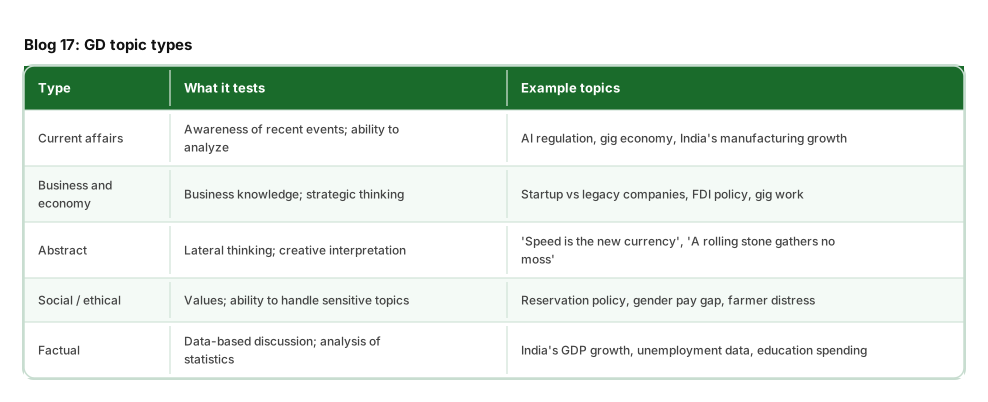
Types of GD Topics You Will Encounter

20+ GD Topics for MBA 2026 With Key Points
1. AI Will Replace Human Jobs (Debate Both Sides)
For: Automation is already displacing routine jobs in manufacturing, data entry, customer service. NASSCOM estimates automation has eliminated or transformed 500,000-plus BPO roles in the last 5 years. Against: AI creates new job categories; industrial revolutions historically created more jobs than they eliminated. The printing press did not end writing jobs. Key insight: The impact is uneven. Low-skill routine work is most at risk, while roles requiring judgment, creativity, and relationships are growing. India's challenge is that its large workforce is disproportionately concentrated in routine work.
2. Is the Gig Economy Good for India?
For: 7 to 8 million workers now in India's gig sector (Swiggy, Zomato, Ola, Urban Company); provides income flexibility, fills formal employment gaps. Against: No social security, no minimum wage guarantee, platforms can deactivate workers without notice. Key data: NITI Aayog 2022 report projected 23.5 million gig workers in India by 2030. The issue is not gig work itself. It is the absence of a regulatory floor.
3. India's Manufacturing vs Services Debate
Manufacturing case: Creates more employment per unit of investment; national security argument (reduce import dependence); PLI schemes are working for electronics and semiconductors. Services case: India's comparative advantage is in technology services; IT plus BPO exports are USD 200-plus billion annually; switching strategy mid-stream risks both. Nuanced view: Both sectors are needed. Manufacturing for employment; services for forex and high-value growth. They are not competing.
4. Online Education: Disruption or Supplement?
Disruption view: Covid proved that high-quality education can be delivered online; IIT Madras's online BS program has 35,000-plus students. Supplement view: Peer learning, campus networking, and practical experience cannot be replicated digitally; employer preferences still favor campus degrees for senior roles. Key insight: Online is genuinely disrupting skill-based and professional learning; it is supplementing rather than replacing degree-level higher education.
Find the Best online MBA for You
Compare top online MBA universities in India: fees, accreditation, placements, and specialisations side by side.
Compare MBA Universities5. Should India Implement a Wealth Tax?
For: Reduces inequality; India's top 1 percent hold 40 percent of total wealth (Oxfam 2024); additional revenue for social spending. Against: Capital flight risk; implementation and enforcement challenges; may deter investment. Key nuance: The effectiveness depends entirely on implementation design. Poorly designed wealth taxes have been repealed in 12 European countries.
6. Social Media: More Harm Than Good?
Harm: Misinformation spreads faster than corrections; documented link between heavy social media use and youth mental health deterioration (APA 2023); political polarization. Good: Democratizes information access; enabled India's farmer protests of 2020-21 to reach global attention; connects businesses with consumers. Key: The harm-vs-good framing is the wrong frame. The question is governance, not existence.
7. Speed Is the New Currency (Abstract)
Interpretation 1: In business, first-mover advantage is decisive. Amazon, Flipkart, OYO all scaled fast and dominated before competition caught up. Interpretation 2: Speed without direction is not valuable. Reckless scaling without sustainable models leads to failure (WeWork, Byju's). Balanced argument: Speed matters, but speed of the right things (product-market fit, customer understanding) is what creates value.
8. A Rolling Stone Gathers No Moss (Abstract)
Classical reading: Constant movement prevents accumulating skills, relationships, and depth. Modern counter-reading: In today's job market, staying too long in one role or skill set leads to obsolescence. Synthesis: The question is whether your movement is driven by curiosity and growth, or by restlessness and discomfort. The former is valuable; the latter is not.
9. India's Demographic Dividend: Opportunity or Burden?
Opportunity: 65 percent of India's population is below 35. Largest working-age population globally by 2030. Massive consumer market plus innovation potential. Burden: Insufficient quality job creation. 12 million enter workforce annually; only 4-5 million quality jobs created. Skills gap is widening. Key insight: It is a time-bound opportunity. India has 15-20 year window before population ages. Action needed: education quality, manufacturing employment, skill development at scale.
10. Should India Adopt Universal Basic Income?
For: Reduces extreme poverty; simplifies welfare delivery; provides safety net for AI-displaced workers. Against: Fiscal cost (estimated Rs 5-7 lakh crore annually); may reduce work incentive; better to invest in education plus healthcare. Key data: India's social spending is 5 percent of GDP vs 10-15 percent for developed economies. Synthesis: Target conditional cash transfers to specific groups, not universal coverage.
11. Cryptocurrency: Boon or Bane for India?
Boon: Financial inclusion for unbanked; cross-border remittance efficiency; technology innovation. Bane: Energy intensive; tax evasion plus money laundering risk; price volatility. Key data: India crypto users 100 million-plus by 2025. Regulatory: SEBI plus RBI plus IT Ministry developing framework. Synthesis: Regulated crypto exchange ecosystem better than outright ban.
12. Climate Change: Should India Slow Down Industrialisation?
For slowing: India is 3rd largest CO2 emitter. Per capita emissions rising. Already facing climate impacts. Against: Climate justice. Per capita India emissions still below developed nations. Industrialisation needed for poverty alleviation. Synthesis: India committed to net zero by 2070. Path: renewable energy investment, green technology, sustainable manufacturing.
13. Is Privatisation of PSUs Good for India?
For: Efficiency gains; reduces fiscal burden; capital infusion; competitive markets. Against: Strategic asset loss; employment concerns; monopoly risks if not regulated. Recent examples: Air India sold to Tatas (positive turnaround). LIC IPO went well. Synthesis: Strategic sectors (defence, atomic energy, railways infrastructure) should remain government. Commercial sectors can be privatised with strong regulation.
14. Should India Have a Common Civil Code?
For: Equal rights across religions; modernisation of personal laws; reduces gender inequality. Against: Cultural sensitivity; minority concerns; complex implementation. Recent: Uttarakhand UCC implementation 2024. Synthesis: National conversation needed. Implementation must balance equality, cultural sensitivity, minority protection.
15. Is the 4-Day Work Week the Future?
For: Iceland, UK trial pilot studies show no productivity loss; better work-life balance; mental health benefits. Against: Service industry disruption; some sectors cannot adopt; pay implications unclear. India context: Software plus services could adopt easier than manufacturing or healthcare. Synthesis: Sector-specific adoption with productivity-linked compensation.
16. India vs China: Who Wins the 21st Century?
China advantages: Manufacturing scale, infrastructure, R&D spending, geopolitical reach. India advantages: Demographic dividend, democracy, English-speaking workforce, growing tech ecosystem. Synthesis: Not zero-sum. Both can grow. India needs to invest in education, manufacturing, infrastructure to close gap.
17. Should EVs Be Mandatory in India by 2035?
For: Reduces oil import dependence; climate commitments; air quality improvement. Against: Infrastructure unprepared; battery sourcing challenges; affordability for masses. Government targets: 30 percent EV adoption by 2030. Synthesis: Gradual transition with hybrid technology, charging infrastructure investment, battery manufacturing PLI.
18. Is Reservation System Still Relevant in India 2026?
For: Historical injustice; representation in education plus government; affirmative action principle. Against: Caste-based system in 2026; merit concerns; needs economic criteria. Synthesis: EWS plus quota added 2019 already moves toward economic criteria. Continuous evaluation plus modernisation needed.
19. Is GST a Success in India?
For: Unified tax system; reduced cascading; revenue stability; formalisation. Against: Complex rate slabs; small business compliance burden; states' revenue concerns. Data: GST collections crossed Rs 1.78 lakh crore monthly average 2025. Synthesis: Refinements needed (single rate eventually, simplified compliance) but overall positive.
20. Should Education Be 100 Percent Free in India?
For: Equity; reduces inequality; investment in future. Against: Fiscal capacity; quality vs quantity trade-off; private sector role. Current: Government school fees free up to Class 12. Higher education subsidised. Synthesis: Quality plus access matter equally. Free education alone without quality control reduces outcome value.
GD Dos and Donts: The Short Version
Do: Start with a framing statement that sets direction for the group. Build explicitly on what the previous speaker said. Invite quiet participants ('I think [name] had a point earlier about...').
Do not: Raise your voice to compete with others. Repeat the same point twice. Focus entirely on how much you speak rather than whether what you say adds value.
GD Evaluation Parameters at Top MBA Colleges 2026
- Content quality: Substantive points, data-backed arguments, balanced perspectives (25 percent weightage).
- Communication skills: Clarity, articulation, English fluency (20 percent).
- Listening plus collaboration: Building on others' points, inviting participation (20 percent).
- Structured thinking: Logical flow, pros plus cons analysis, synthesis (15 percent).
- Leadership behaviour: Initiative, steering discussion productively (10 percent).
- Conclusion plus consensus: Summarising group views (10 percent).
GD Plus WAT Plus PI Combined Strategy 2026
Most IIM admissions use a combined process. GD plus WAT plus Personal Interview together carry 30-40 percent weightage in final selection after CAT score.
- WAT (Written Ability Test): 200-300 word essay in 20-30 minutes. Tests structured writing.
- GD (Group Discussion): 15-20 minute conversation in 8-12 candidate groups.
- PI (Personal Interview): 20-30 minute interview. Assesses fit, motivation, depth.
The most common reason candidates fail GD rounds is not lack of knowledge. It is that they treat it as a competitive monologue rather than a collaborative discussion. Panelists are evaluating future managers. Managers need to build consensus, not win arguments.
GD Topics by Theme for MBA 2026 (Quick Reference)
- Technology plus AI: AI job displacement, GenAI ethics, automation impact, data privacy.
- Economy: GDP growth, inflation, wealth tax, GST, FDI.
- Society: Inequality, women's workforce participation, mental health, social media impact.
- Governance: UCC, electoral reforms, RTI, freedom of speech.
- India plus World: India-China relations, geopolitics, climate change, trade.
- Abstract plus Philosophical: Success metaphors, time, change, leadership.
- Education: Online vs campus, reservation system, skill development, NEP 2020.
- Business plus Leadership: Startup culture, gig economy, corporate ethics, ESG.
GD Preparation Strategy for MBA Aspirants 2026
- Build current affairs base: Daily reading of The Hindu, Indian Express, Mint for 3-4 months pre-admission. 30-60 minutes daily.
- Practise structured speaking: Mirror practice plus video recording. Time yourself for 2-3 minute responses on topics.
- Group practice sessions: Join MBA aspirant WhatsApp groups for mock GD plus virtual practice.
- Learn the framing technique: Always state your stance plus 2-3 supporting arguments plus 1 counter-acknowledgment.
- Read both sides of every topic: Be ready to argue for or against any position.
- Practice abstract topics: Develop 2-3 interpretations for proverbial topics.
- Build the conversation muscle: Listen to podcasts (Daily, Planet Money) for cadence.
- Mock GD attempts: Minimum 10-15 mock GDs before actual admission cycle.
GD success in MBA admissions is fundamentally about converting prep into composed, intelligent participation in a real-time group conversation. Memorising facts on 30 topics matters less than developing the listening plus building plus framing skills that make group discussions productive. Practice the cadence plus content together, and the GD round becomes a strength rather than a hurdle. Build the muscle through 10-15 mock GDs before your actual admission cycle. While preparing for GD rounds, also invest time in writing a strong career objective for your resume since shortlisting happens before the GD stage. Before the GD round, confirm your application is in order by reviewing MBA admission preparation requirements on the eligibility guide.
Find the Best Online MBA for You
Compare top online MBA universities in India: fees, accreditation, placements, and specialisations side by side.
Compare MBA UniversitiesFind the Best Online MBA for You
Compare top online MBA universities in India, fees, accreditation, placements, and specialisations side by side.
Frequently Asked Questions
Typically 10 to 20 minutes for the discussion itself. Each candidate is expected to contribute meaningfully 2 to 3 times. Some institutes also use a 'fish bowl' format with observers.
WAT (Written Ability Test) is a 200 to 300-word essay written in 20 to 30 minutes on a given topic. It tests written communication and structured thinking. <a href="/blog/iim-ranking-india-2026-all-iims-list" style="color:inherit;text-decoration:underline;text-underline-offset:2px">IIM admissions</a>s use WAT in addition to or instead of GD at different stages.
A good GD conclusion summarizes key points made by the group (not just yours), notes where consensus was reached and where differences remain, and offers a balanced final observation. Avoid strong one-sided conclusions, they signal that you were not listening.
Was this article helpful?
Share this article