

- ✓Which is the most toughest exam in India?
- ✓Which is the hardest exam in the world?
- ✓Is IIT JEE harder than UPSC?
Last updated 14 May 2026 by Rishi Kumar, Senior Education Researcher and Founder, EdifyEdu. Data sourced from UPSC, JEE Apex Board, NEET NTA, ICAI, ICSI annual reports, plus Gaokao plus All Souls historical pass-rate records.
The Toughest Exams in India and the World 2026: Real Pass Rates, Real Stakes
Two of the world's top three toughest exams are Indian. That is not a boast. It reflects a specific combination of factors that India's competitive exams have in abundance: enormous candidate pools, multi-stage elimination, vast syllabi, and career stakes so high that students sometimes spend five or more years preparing.
Here is the honest, data-backed breakdown.
What Makes an Exam Genuinely Hard?

Low pass rate alone is not enough. An exam that 10,000 people take with a 1 percent pass rate is harder to compare to one that 14 million people take with a 0.003 percent pass rate. Difficulty is a combination of four things:
- Scale of competition: How many people are competing for how many seats
- Elimination structure: How many stages you must survive, not just pass
- Syllabus breadth and depth: How much you must know at what level
- Career stakes: What happens if you do not pass, and whether a second attempt is realistic
India's Top 5 Toughest Exams
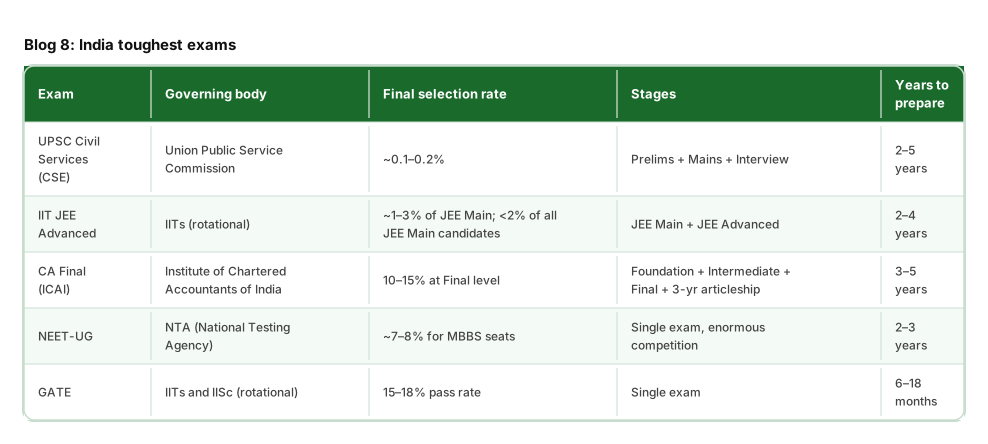
1. UPSC Civil Services: India's Most Intense Exam
Over 13 lakh people apply for UPSC Civil Services every year. About 10,000 make it past Prelims. Around 2,500 clear Mains. Roughly 1,000 are finally selected.
The syllabus covers Indian history, geography, economics, polity, international relations, science and technology, environment, ethics, and current affairs, plus one or two optional subjects of the candidate's choosing. The Mains has nine papers, including essay writing and general studies across multiple domains. The Interview tests personality, communication, and judgment.
Six attempts for General category candidates. Nine for OBC. No limit for SC plus ST.
UPSC is not just a knowledge test. It is a test of sustained commitment. Most successful candidates have spent 2 to 5 years preparing, often at significant financial and personal cost. The ones who clear it are typically not the most intelligent. They are the most consistent.
Ready to Upgrade Your Qualifications?
Compare 50+ UGC DEB approved universities offering online MBA, MCA, BBA, BCA, B.Com all in one place.
Compare Universities2. JEE Advanced: Math, Physics, and Chemistry at Extreme Depth
JEE Main screens out everyone except the top 2.5 lakh students from 14.76 lakh who sat the exam in 2025. Of those 2.5 lakh who take JEE Advanced, about 54,000 qualify for IIT admission. IIT seats total approximately 17,000. That is an effective admission rate below 2 percent from all JEE Main candidates.
What makes JEE Advanced uniquely hard is not volume of content. It is the depth. Questions require genuine conceptual understanding, not formula application. Format changes every year, so rote strategies fail. Students who score 90th percentile in JEE Main often struggle to clear JEE Advanced.
3. CA Final: The Long Game
Becoming a Chartered Accountant requires passing three exam levels (Foundation, Intermediate, Final) plus three years of mandatory articleship training. The CA Final pass rate consistently sits between 10 and 15 percent, and most candidates take multiple attempts to clear all papers in a single attempt.
The total journey, from Class 12 to CA designation, takes most candidates 5 to 7 years. The syllabus at Final level is equivalent in depth to a postgraduate degree in accounting, auditing, taxation, and financial management.
4. NEET-UG: Medical Entrance Battle
NEET UG receives 23 lakh-plus applications annually for approximately 1.09 lakh MBBS seats nationally. Effective admission rate to government MBBS: under 1.5 percent. To top AIIMS plus JIPMER plus government colleges, the rate drops to 0.05 percent.
NEET tests Physics, Chemistry, Biology at depth. 180 questions in 200 minutes. Coaching cost can reach Rs 3-8 lakh across 2 years. Most successful candidates start dedicated prep from Class 11.
5. GATE: India's Engineering Postgraduate Filter
GATE has approximately 8 to 10 lakh aspirants annually. Used for IIT plus NIT M.Tech admission plus PSU recruitment. Top 1 percent qualify for IISc, IIT M.Tech with stipend. Top 0.5 percent qualify for PSU jobs.
Syllabus depth equivalent to a strong B.Tech graduate. Format change in recent years (MCQ plus MSQ plus NAT) increases unpredictability.
India's Toughest Exams by Pass Rate 2026 Table
| Exam | Total Aspirants | Seats or Selections | Pass or Selection Rate | Prep Time |
|---|---|---|---|---|
| UPSC CSE | 13 lakh-plus | 900 to 1,000 | 0.1 to 0.2 percent | 2 to 5 years |
| JEE Advanced | 14.76 lakh (Main) | 17,000 IIT seats | Below 2 percent | 2 to 3 years |
| CA Final | 1.5 to 2 lakh per session | 15-20K pass | 10 to 15 percent | 5 to 7 years total |
| NEET UG | 23 lakh-plus | 1.09 lakh MBBS seats | Below 1.5 percent govt | 2 to 3 years |
| GATE | 8 to 10 lakh | Top 1 percent qualify | 1 percent for IIT M.Tech | 1 to 2 years |
| CAT | 3 lakh-plus | Top 100 IIM A, B, C | 0.1 percent for top IIM | 1 to 2 years |
| CLAT UG | 70,000-plus | NLU seats 3,000 | 4 percent | 1 to 2 years |
| NDA | 4 to 5 lakh | 700 to 800 selections | Below 0.2 percent | 1 to 2 years |
| RBI Grade B | 1 to 2 lakh-plus | 200-300 selections | 0.1 to 0.3 percent | 1 to 2 years |
| SBI PO | 10 lakh-plus | 2,000 selections | 0.2 percent | 6 months to 1 year |
Top 5 Toughest Exams in the World
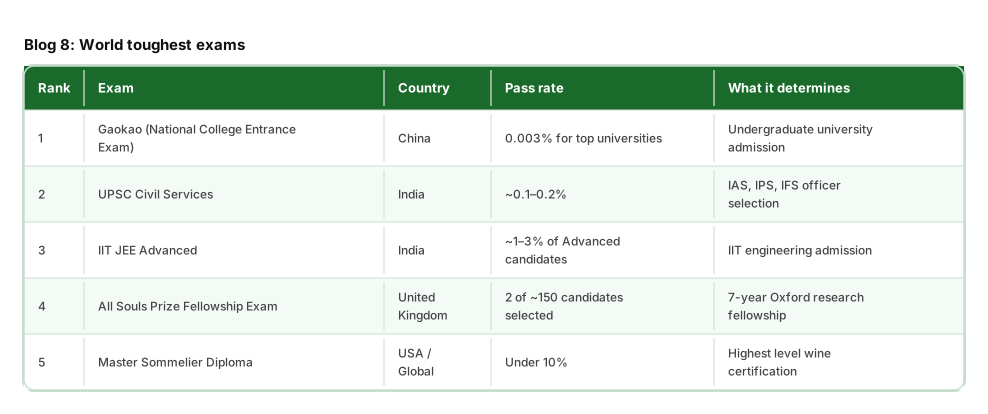
1. The Gaokao: Scale, Pressure, Near-Zero Margin
More than 13 million Chinese students sit the Gaokao every year. For top universities like Peking and Tsinghua, the effective admission rate is 0.003 percent. The exam lasts 9 hours across two or three days. Most students have been preparing for it since middle school. Some for their entire academic life.
The pressure is cultural as much as academic. A family's social mobility often hinges on one child's Gaokao score. That context makes it uniquely brutal.
2. All Souls Prize Fellowship: The Exam Only Oxford Insiders Know
All Souls College at Oxford offers prize fellowships through a two-day exam taken by around 150 candidates annually. Two fellowships are awarded. The exam tests scholarly depth and original thinking across philosophy, law, history, and economics, with no specified syllabus.
It is arguably the most intellectually demanding exam in the world per seat available. It is also the least known outside academic circles.
3. USMLE Step 1: US Medical Licensing
USMLE Step 1 is the first of three medical licensing exams in the United States. Pass rate around 91 to 96 percent for first-time test takers, but the difficulty is in preparation depth (8 to 12 months of intense study) plus question complexity. International medical graduates pass rate is significantly lower at 75 to 80 percent.
4. CFA Level 1, 2, 3: Investment Management Globally
Chartered Financial Analyst exam has three levels. Pass rates: Level 1 (38-42 percent), Level 2 (44-46 percent), Level 3 (48-55 percent). Total prep time across 3 levels: 900-1000 hours. Globally about 30-35 percent of those who start CFA Level 1 ever clear Level 3.
5. LSAT: US Law School Admission
LSAT is required for US law school admission. While not technically pass-or-fail, achieving the score needed for top law schools (170-plus out of 180) requires extensive preparation. Top law schools admit about 10-20 percent of LSAT takers.
World Toughest Exams Comparison Table 2026
| Exam | Country | Aspirants | Pass or Selection Rate |
|---|---|---|---|
| Gaokao | China | 13 million-plus | 0.003 percent to top universities |
| All Souls Prize Fellowship | UK (Oxford) | 150 | 1.3 percent (2 from 150) |
| USMLE Step 1 | USA | 30,000-plus | 91 to 96 percent (US grads), 75-80 percent (IMG) |
| CFA Level 3 | Global | 30,000 worldwide | 48 to 55 percent per attempt |
| LSAT (for top US law schools) | USA | 150,000-plus | 10-20 percent for top schools |
| UPSC CSE | India | 13 lakh-plus | 0.1 to 0.2 percent |
| JEE Advanced (to IIT) | India | 14.76 lakh JEE Main | Below 2 percent admission |
| Mensa IQ Test | Global | Self-selected | Top 2 percent IQ |
India's Unique Position in Global Exam Landscape
India occupies the top three positions in global exam difficulty rankings alongside China, which tells you something about how both countries structure education and competition. The common thread is not the exam content itself, but the ratio of aspirants to available seats.
When 13 lakh people compete for 1,000 government jobs, or 23 lakh people compete for 1 lakh MBBS seats, the selection process becomes an exercise in elimination at every stage. The exam is hard partly because the stakes make it hard.
What Makes Indian Exams Uniquely Tough 2026
- Volume of competition: India's demographic dividend means massive cohorts compete for limited seats.
- Long prep timelines: 2-5 years of focused prep is common (UPSC, NEET, JEE).
- High family financial sacrifice: Coaching plus living costs add Rs 5-15 lakh over preparation years.
- Personal sacrifice plus social isolation: Aspirants often live in coaching hubs (Kota, Karol Bagh) away from family.
- One-shot decisive moments: Single exam day decides 5-7 years of effort.
- Limited backup options: Failed attempts can mean career setback at critical age window.
- Cultural expectations: Family plus social prestige tied to specific exam outcomes.
Toughest Exams FAQ 2026
- Why is UPSC considered toughest in India?: 13 lakh aspirants to 1,000 selections (0.1 to 0.2 percent). Multi-stage elimination across 1.5 years.
- Can I clear UPSC plus IIT JEE plus CAT?: Extremely rare. Each requires 2-3 years dedicated prep. Sequential attempt possible across 7-10 years.
- Is CA tougher than MBA from IIM?: Different difficulty types. CA is technical depth plus articleship. IIM MBA is application plus communication intensive.
- Are coaching institutes essential for India's toughest exams?: For UPSC, JEE, NEET, CAT: very helpful but not strictly essential. Self-study toppers exist but are minority.
- What is the financial cost of preparing for India's toughest exams?: UPSC Rs 5-15 lakh over 2-5 years. JEE Rs 4-8 lakh over 2-3 years. CA Rs 1-3 lakh over 5 years. Coaching plus living costs vary by city.
- Can I prepare for India's toughest exams while working?: Difficult but possible for CAT, RBI Grade B. UPSC plus CA Final plus JEE require dedicated 12+ hour daily study.
India's toughest exams reflect the country's demographic reality and aspirational social structure. UPSC plus JEE Advanced plus CA Final represent the top three by combined factor analysis: scale, elimination structure, syllabus depth, and stakes. Globally, China's Gaokao plus Oxford's All Souls plus the global CFA programme represent the world's hardest tests. Success in any of these requires extraordinary commitment plus consistent execution over multi-year preparation timelines. The right preparation strategy plus realistic backup plans plus emotional resilience together determine outcomes more than raw intelligence alone.
For aspirants preparing for any of these exams in 2026, the single most important factor is consistency over multi-year preparation horizons. Coaching institutes plus test series plus peer study groups all add value but cannot substitute for daily disciplined effort. Build a sustainable study plus revision schedule, plan financial runway, plus prepare backup options. The exam is one milestone in a longer career trajectory. Success or partial success both open meaningful career paths if pursued with strategic clarity.
Many aspirants who clear India's toughest exams report that the discipline plus resilience built during preparation transfers to professional success. Even those who do not clear specific exam targets often build skill sets plus mental toughness that compounds across entire careers. The preparation journey itself is high-value if approached deliberately. Pick exams matching your strengths plus career goals, plus commit fully to consistent disciplined preparation regardless of outcome certainty.
Ready to Upgrade Your Qualifications?
Compare 50+ UGC DEB approved universities offering online MBA, MCA, BBA, BCA, B.Com all in one place.
Compare UniversitiesReady to Upgrade Your Qualifications?
Compare 50+ UGC DEB approved universities offering online MBA, MCA, BBA, BCA, B.Com, all in one place.
Frequently Asked Questions
<a href="/blog/ias-officer-salary-india-2026-pay-scale-perks" style="color:inherit;text-decoration:underline;text-underline-offset:2px">IAS officer salary</a> is widely considered India's toughest exam, with a final selection rate of approximately 0.1 to 0.2% across three elimination stages. JEE Advanced and CA Final are close competitors depending on how you measure difficulty.
The Gaokao in China is widely regarded as the hardest exam by scale, 13+ million candidates for elite university seats with a 0.003% success rate at the top. UPSC and JEE Advanced are in the global top three by selection rate.
They test different things. JEE Advanced demands extreme analytical depth in PCM. UPSC demands broad knowledge across dozens of subjects plus writing and interview skills. Many people who clear one would struggle with the other.
UPSC CSE, IIT JEE Advanced, CA Final (ICAI), NEET-UG, and GATE, based on selection rates, syllabus breadth, and preparation time required.
Was this article helpful?
Share this article